Friday, April 21, 2023

New York International Auto Show - All of the Electric Vehicles!

 I went to the NY Auto Show last wee, specifically to see the various EV's that are now for sale.... And I have t say, I was very surprised at the number that are currently available in the US! I consider myself pretty knowledgeable in this space, but it was great to see (almost) every new EV currently available, as well as a few that are hopefully 'coming soon'. This disappointment stems from the LACK of EV's from some of the large manufacturers of popular cars, but I'll discuss that a little later.

First, here are the ones you can order and/or buy now, in no particular order....


First up is Ford, with 2 vehicles there (as well as a Transit E-Van) - the Lightning Pickup and the Mach-E - they had several of each, and were doing a little Mach-E ride-along... First time I had the chance to see the Lightning up close and it's impressive - certainly full-sized, and with a massive frunk that opens up right down to the bumper. I'm guessing Red Bull is a sponsor...

Ford F150 Lightning 


Ford Mustang Mach-E


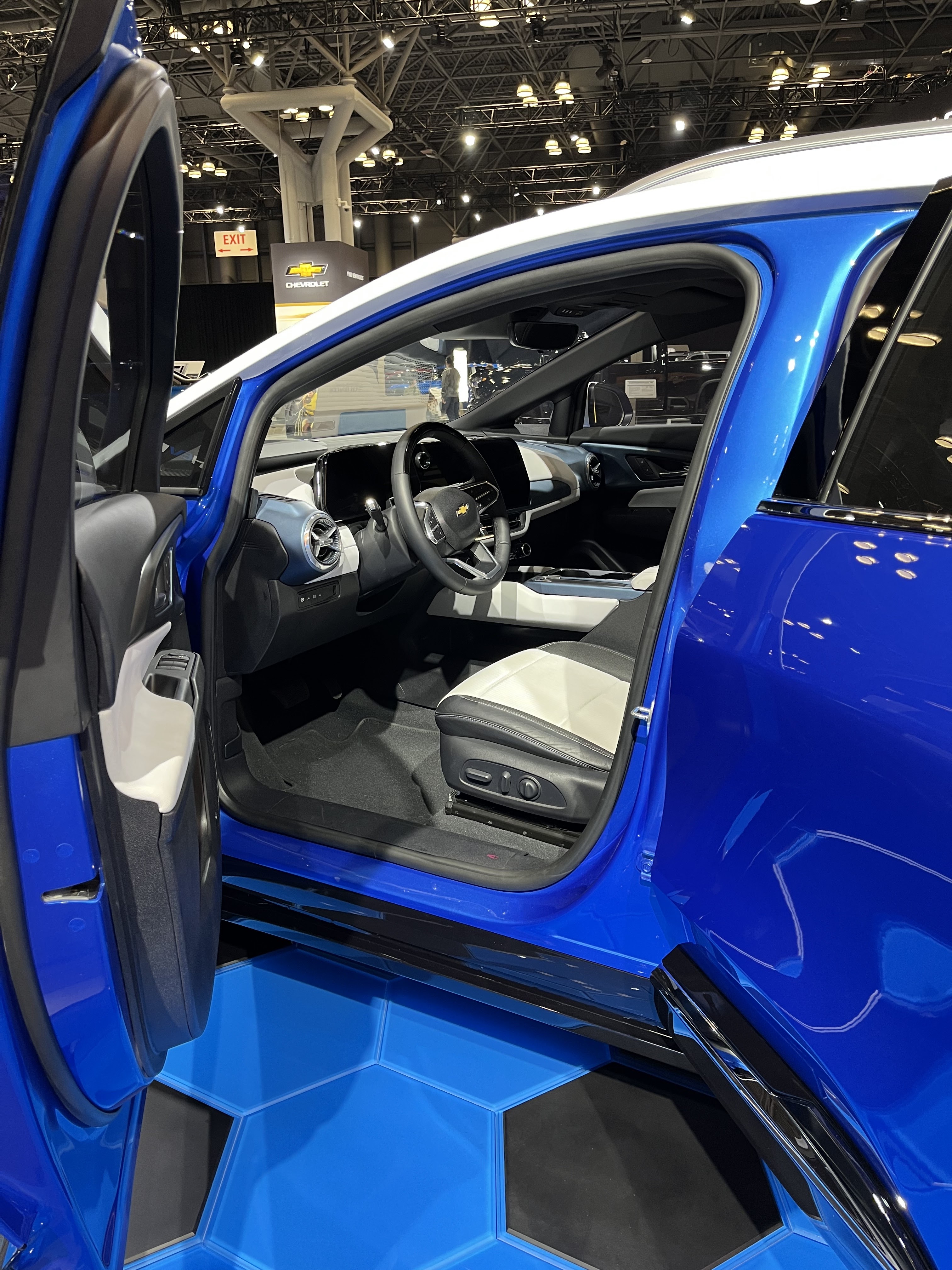
Next up was Chevy with several up-coming cars (some of which I believe you can pre-order now) - 

First up is the Equinox, which Chevy has been touting as starting at around $30,000. I imagine the one on display is a top-of-the-line model, but it looks pretty sharp.


Chevy also had the Blazer EV which seems to be a similar size as the Equinox but I imagine will be a bit more up-market as it's starting price is supposed to be around $45,000.


Silverado EV Pick-Up


Subaru showed up with their version of the Toyota bZ4X, the Solterra, It's a poor effort, just like the bZ4X. Hopefully the Japanese manufacturers (Toyota, Honda, Subaru mainly) start to take EV's seriously at some point, as they could certainly make them at a high level if they actually cared. Not all of the fingerprints on the 'piano black' console cover. No one really uses PB any longer for this exact reason.


Stellantis was the next stop, they have no current modern EV's, only the Fiat 500e which is admittedly cool, but not really useful in the real world if you drive a lot of daily miles. They did have a 'future' vehicle, the Chrysler Airflow, the Challenger EV and a weird 2-seat golf-cart kind of thingy that serves no purpose, but was kind of cool none-the-less.

Chrysler Airflow


?


FIAT 500e


Challenger EV 


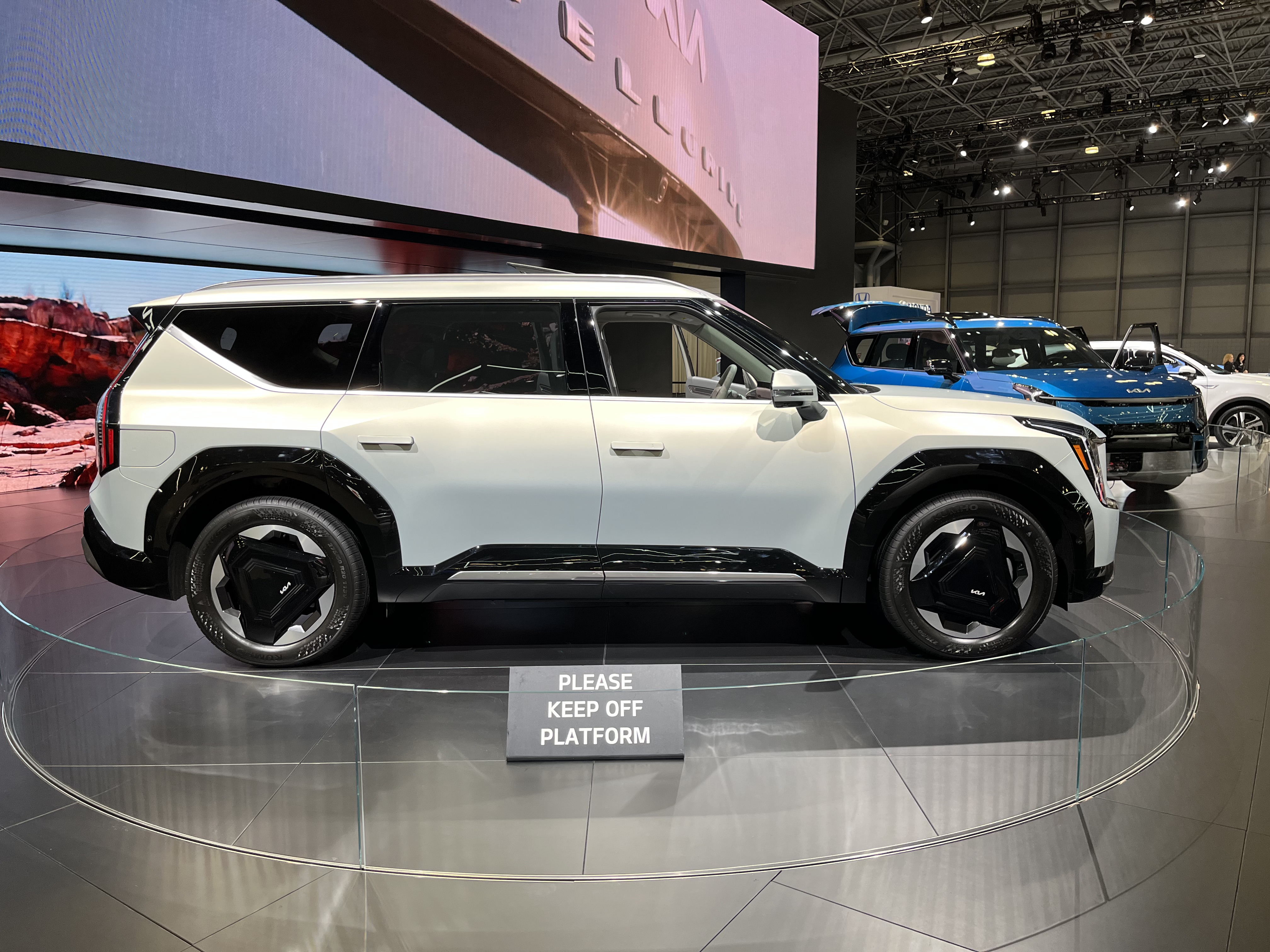
Next up were the real stars of the show, in my view - Kia and Hyundai. They have really bought in to the idea of EV's and are making some really good ones - both in design and in features and capabilities.
Kia EV9 - a full-sized, 3-row SUV


EV6 in GT guise


Niro EV


Hyundai Ioniq 6 - gorgeous!


This is actually a beautiful dark green


Ioniq 5


Hyundai's version of the Niro, the Kona


Genesis, which is Hyundai's luxury division (see: Lexus) had a couple of EV's as well. The GV60 is the SUV and the G80 is a large sedan, which they called by the awkward name of 'Electrified'. But their paint is incredible.

GV60


G80 Electrified


BMW showed 2 of their EV's. The German companies are making a bit of noise in this space, which is nice to see - although BMW has completely lost their way styling-wise. Fortunately, when driving one, you don't have to look at the hideous front end... Unfortunately, they were roped off with no one there, so you could only stare in dismay at the front of the cars.

BMW iX


i4


Ram showed off their upcoming full-sized truck EV, the RAM EVO. They have taken a page from Ford in that the vehicle is very 'trucky' with a few EV hints. Hopefully it does as well as the F150 Lightning...


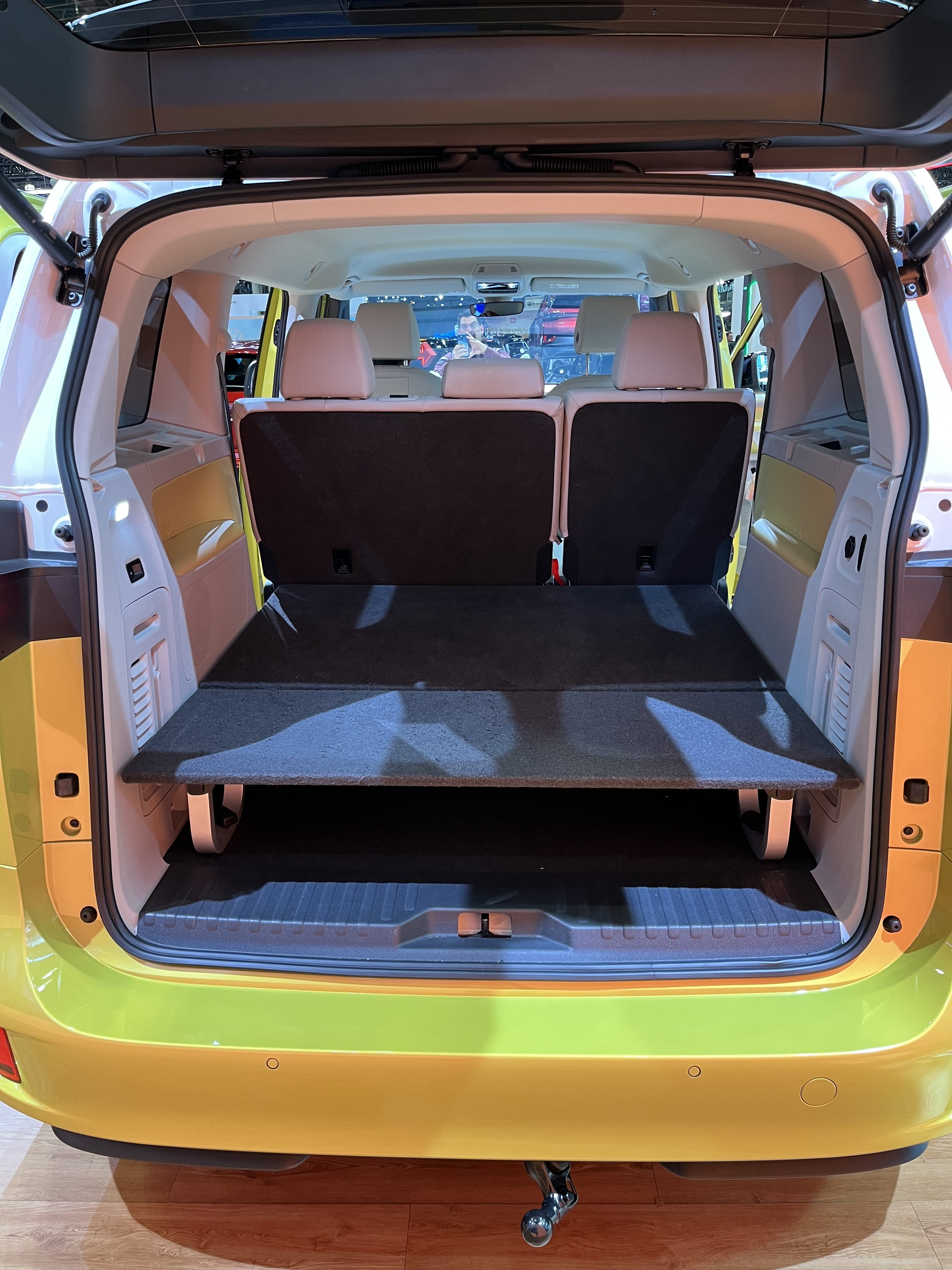
VW is another company getting ready to make a big move into EV's, although they only had 2 on display - the ID.4 which has been on sale for a couple of years, and the ID.Buzz, their VW Van remake - which was very cool...

'Split' ID.4


ID.Buzz - could not get inside as there was a line right after I took these pics...


ID.4 dashboard - ID.Buzz is the same


Finally, Nissan had several of their new Ariya cross-over EV's. The interior is very nice although the overall specs are a little underwhelming.


Some no shows: Mercedes which was a bit of a surprise - they are rolling out a new EV every couple of months, it seems. Also, Volvo was a no-show as well. Polestar and Audi were in a roped off section. The former only had one Polestar 2, along with a Polestar 1 hybrid. Audi had an e-tron Sportback which I would have liked to have sat in. Their loss. No Porsche. No Honda, who amazingly doesn't make an EV for US consumption.... And there were no Rivians, Lucids or Teslas on the main floor (although I heard later on that there was a Rivian pick-up in the aftermarket area - missed it. 

Overall, it's really encouraging to see all of the new EV's that are out there or coming very soon! It's a great time to be an EV enthusiast - more choices are always better, and the technology is only going to get better, more efficient and less costly..

Friday, February 24, 2023

Supercharger Visits

 I recently came across a site that lets you log in your Supercharger visits and create a map of where you have charged while on the road. Here is mine (although I have done a couple more since, but no new ones) -


These are 'unique' visits - many of these I have visited multiple times. I've never had to wait, and I've run into broken or unavailable Superchargers only twice. Hopefully this continues to be the case when they start to open up to non-Tesla EV's.

I hope to expand this in 2023!


Tuesday, December 6, 2022

Tesla Full Self-Driving Preview!

 After a couple of attempts, I was finally able to get access to the Full Self-Driving 'Autosteer on City Streets' beta (otherwise known as FSD beta). Here's what you need to do to get FSD and then the beta -

1) Subscribe to FSD through the app - it's currently $200/month. Or, you can purchased FSD outright - currently, that will set you back $15k....

2) Once it's active, you get access to 6 of the 7 capabilities that are part of FSD -

- Navigate on Autopilot (ability for the car to self-drive from on-ramp to off -ramp on highways).

- AutoPark - car can park itself is parallel or curb parking spots.

- Summon - car can back itself out of, or pull into, a garage.

- Smart Summon - car can autonomously drive to you in a mall parking lot.

- Auto Lane Change - car will initiate and make lane changes automatically when you signal.

- Traffic and Stop Sign Control - when using Autopilot, the car will stop for red lights and stop signs.

The big feature, and the one that everyone talks about, is Autosteer on City Streets. This is currently available as a beta feature so essentially, when you get this, you become a tester for Tesla. Data from your usage is fed back to Tesla to increase the knowledge base in their network. It is still very much a work in progress, as numerous Tesla testers have shown. My own experience after a couple of weeks has shown the same.

To get access to the FSD beta, once you have subscribed or purchased FSD, you then click a button on the car's screen requested access to the beta. Then you have to do a couple of things -

1) Drive 100 miles on Autopilot (which is the Traffic-Aware Cruise Control and Autosteer) - this should be done on a highway.

2) Maintain a decent Safety Score. The SS pops up on the Tesla phone app when you hit that request button on the screen, and monitors your driving habits - specifically, Forward Collision Warnings, Hard Barking, Aggressive Turning, Following Too Closely and Autopilot Disengagements. You typically need to be above an 80 to get access to beta. You have to maintain a score for about 7 days before getting beta access.

So, once you do those 2 things, based on current timeframes, you should get into the beta, and the fun begins!

The first chance I had to try it out was the Wednesday before Thanksgiving. Here are a couple of videos that I took that day -

This first one is just a straight shot down a divided 4-lane road in our town -


The second video is further down the road, preparing to make a turn onto another divided 4-lane -


The final video is making a left-hand turn into my neighborhood. The car in front of me actually did a U-turn which seemed to confuse the car as it basically stopped. I took over as I had traffic behind me.


So that's the initial look. I've done some other tests without videos, but will do some more videos shortly. My subscription ends at the end of December so I have some time. Stay tuned!


EV's in the Comics


Came across this a couple of weeks ago - thought it was funny!


Stay tuned for some new entries - sorry that I haven't been very good about updating this. But I have a lot of material to post!

Wednesday, January 12, 2022

Battery Usage While Stuck


The recent incident with hundreds of cars stuck on I-95 in Virginia during the snowstorm has raised a lot of questions regarding EV vs ICE vehicles - what happens if you're stuck like that in an EV? Won't the battery die quickly if you have to use the HVAC to stay warm?

The short answer is that you'd probably be better off in an EV than a gas-powered vehicle, assuming to have similar level of energy available to power the car. That is, you can't compare an ICE vehicle with, say 3/4 of a tank of gas to an EV with, say, 20% of charge. But assuming both have a similar percentage of their total tank/battery filled, the EV is actually better.

The main reason for this has to do with the engine and motor, respectively, of the ICE vehicle and the EV. The engine in an ICE vehicle is CONSTANTLY running (let's put aside those stop/start systems for a second) - when you start the car until you turn it off. Idle, high-speed, city driving - the engine is always using gas. With an EV, OTOH, the motor(s) is only using energy from the main high-voltage battery when the car is moving under power - that is, accelerating or maintaining speed. Unlike an ICE vehicle, when you remove your foot from the accelerator, the motors do not use energy and actually, through regenerative braking, put some energy back into the battery. So, the major source of energy usage for an EV, the motor, is basically using zero energy when you are stopped. 

So take the situation down in Virginia a couple of weeks ago. You have an ICE vehicle and an EV sitting side-by-side on the highway. The ICE vehicle is idling to keep the heat running - and therefore using gas (and also polluting but that's another story). The EV's motor is using no energy. Depending on the car and the HVAC settings, some energy is used to heat the car, but so little that it could literally take days to deplete the battery from a high state of charge to the point where you'd start to get concerned. This is especially true if you have an EV (like a later Tesla) that has a heat pump. They use less energy from the battery to heat the cabin, just like the heat pump in a home. See the Texas power outage in February 2021 as a great example - here is a link to just one story that discusses how people used their Teslas (in their garage) to survive - 

https://electrek.co/2021/03/05/electric-cars-texas-blackout/

How about a personal example? On Tuesday, my wife had oral surgery and due to Covid regulations I could not wait in the office (I didn't want to anyway). The temperature outside was 19 degrees. I waited for slightly over 2 hours in my car, the heat was set at 70 degrees and I had the seat heater on (probably overkill). I was also watching YouTube videos on the car's screen. My battery SOC went from 81% to 79% in that time frame. Extrapolating that, I could have sat there for another 79 hours before my battery would reach a 0% SOC! And I could extend that time period by lowering the temperature, or turning the heat off altogether and just using the seat heaters. Realistically, when the sun went down, the car would use some energy to keep the battery warm, so 79 hours is probably unrealistic. But the point is that the EV has several advantages over an ICE vehicle that MUST run to provide heat to the cabin.

Ok, so how long can an ICE car idle and provide some heat? Here is an interesting article that can help you calculate for your particular vehicle. 

https://www.autotrader.ca/newsfeatures/20190201/how-long-can-you-stay-warm-on-a-tank-of-gas/

The main example they use - a Ford Explorer - comes out to about 33 hours on a full tank of gas. You can certainly extend that by shutting off the car from time to time, but you'd have no cabin heat and when you restart, the engine is now cold and therefor less efficient. Just like in the EV, you can certainly use the heated seats - but now they are running off of the 12v battery, which you need to restart the car. And you don't want to use the radio when the car is off, as it would further deplete the 12v battery. 

So, the bottom line is that being in an EV might actually be a better choice if you're stuck in a storm. You should certainly take the precautions you would with an ICE vehicle - make sure you have sufficient fuel if you're traveling during inclement weather, have a safety kit, etc. But don't sweat it out in your Tesla, ID.4, Mustang Mach-E or whatever. Just make sure to offer a warm space to those stuck in their gas cars. 😃


Friday, December 3, 2021

Cape Cod Road Trip - August 2021


Hard to believe it, but I never put together a blog entry about our annual vacation trip to Cape Cod back in August.... This was our third road trip, after one to Saratoga Springs in April and one to Boston in May. Better late than never I guess!

We own a time share in West Yarmouth, which is next to Hyannis, the largest town on the Cape. There are only 3 Supercharger locations on Cape Cod, but the Hyannis SC is only about 10 minutes from our time share. So I figured that would be fine as long as it wasn't too crowded. We don't typically drive much once we get to the Cape, other than to dinner and some shopping. Some years we might drive to Provincetown or the National Sea Shore, but didn't have a desire to do the former and the number of shark sightings eliminated the latter from consideration!

We left home at 5:00 am on Saturday, August 7, to head up Route 95. I had charged to 95%, so we had plenty of juice to start, We had one planned stop, in New London, CT, at 26% state of charge, and the car advised charging for 20 minutes (to 75%) to be on our way. We used the restroom in a supermarket and when we got back to the car, it was charged and we were on our way. Between home and New London, we drove pretty efficiently, using 262 watt-hours per mile (similar to MPG with a gas car, except lower is better). That's 82% efficiency, which I was happy with. Cost was $0 as I still had free Supercharging miles from purchasing the car.

We arrived at our destination (the Keltic Kitchen, for traditional breakfast!) and since we couldn't check in until the afternoon, decided to head over to the Hyannis Supercharger for some juice. Our trip from New London to Hyannis was at 88% efficiency, probably helped by some traffic over the Sagamore Bridge (slower speeds). We got there with 21% SOC and let it charge up to 76%, which took about 19 minutes. Again, no cost due to free credit. And the SC location was empty although a pickup truck did park there as we were leaving - an ICEhole.

During the week, I charged once, on Wednesday, from 49% to 90% (no cost), and then again Friday evening prior to heading home Saturday morning (69% => 95%). No cost. I didn't really need to charge up on the Wednesday, I guess, since I only used 21% between Wednesday and Friday evening. Lesson learned.

Saturday, we hit the road at 7:00 am after our traditional stop at Bagels and Beyond. I used the Autopilot while I ate my breakfast driving on Route 25 once we were off the Cape, which was great! We stopped in Madison CT where we charged from 28% to 80% and used up the remainder of our free SC credits and an extra $5.10. Took 21 minutes, enough for a bathroom break. Our efficiency was good at 85% and averaged 281 wh/mi. The remainder of the trip ws on that charge, we arrived home at 27% - 90% efficiency, due to some traffic at the GW Bridge, and attaining 265 wh/mi for this leg.

Overall, this really proved to me how great a road trip car the Model Y is. Our charging time both up and back was 40 minutes combined, which frankly wasn't any longer than we would stop driving up in our Mazda CX-5, which would take an entire tank of gas and cause me agita if we got stuck in traffic at the end of the trip. We would always stop once each way for a bathroom break, so no change there. And since the MY is more efficient in slower traffic is, I didn't have any worries about running out of charge while we were in traffic at either end of the trip. 


Charged and ready to go!


Energy usage, Dayton to New London CT


Charging in New London


Charging in New London


At Hyannis MA Supercharger


The rare Model Y Standard Range spotted at our timeshare!

Wednesday, November 10, 2021

First Comparison of Cost of Electricity vs Gas

 It's been just over 8 months since I took delivery of my Model Y, so I figured I can do a quick initial comparison of the cost of charging (both home and on the road) vs the cost of gas I would have used over the same span of time. 

As of today, the car has 9,102 miles on it. When I compare the cost of my utility bill for the months of April - October of 2020 and 2021, the difference is $248.05 (and yes, this includes natural gas usage as well - I said this is just a quick comparison...😉). On top of that, I have to include the cost of Supercharging while on road trips, which adds another $63.92 for a total of $311.97. So, over the 9,102 miles I've driven, charging cost has been $.034 per mile. This is obviously high as it includes the cost of natural gas used to heat my home and run the hot water heater and gas dryer. At some point, I will go back and use just electricity cost in this calculation, perhaps when I've had the car a year. In addition, I got about 600 miles of free Supercharging which I need to account for somehow but for the purposes of this calculation, I'll assume that it's offset by the fact that natural gas cost is included here. 

On the gasoline side, my Mazda CX-5 got around 22 mpg around town and 27mpg or so on the highway, so I arbitrarily picked 25 mpg as the average. Since gas prices have changed so much in the last year, I also arbitrarily picked $3 per gallon (currently above $3.40 here locally). So, for those 9,102 miles, I would have used 364.08 galls, at $3/gallon, that would have cost $1,092.24 and meant that the cost per mile is $.12. So I saved a significant amount in fuel with the Tesla over my CX-5, even with the cost of natural gas in my calculation.

The conclusion is that while I didn't buy the Tesla purely for the fuel savings, it's pretty remarkable how much less costly it is. Of course, this may change depending on where you live and the cost of electricity, but from what I've seen, New Jersey is in the upper echelon in terms of cost of electricity. And right now, I can't take advantage of off-peak rates as PSE&G hasn't rolled out Smart meters yet, which are needed to track usage by time of day. Once that happens, my cost to charge at home will go down.

In other news, I am able to garage the MY now, as I sold off a project car that had been taking up space for about 20 years.... Pretty excited to be able to get the car in out of the elements for the winter. 


Thursday, August 19, 2021

Charging Fail

 I recently did a short road trip from home here in NJ to visit my parents in Saratoga Springs, NY - drove up Tuesday afternoon and returned Wednesday afternoon. Thought I would just do a quick post regarding the importance of not depending solely on the Tesla Navigation system for charging stops.... Especially if you are still new to the EV world...

Of course, many people wonder what's the deal with doing a road trip with an EV - all the extra time spent charging when you could be driving and filling up at a gas station in 5 minutes and be back on the road.... Well, with the price of gas these days, certainly cost is a factor (electricity is cheaper than gas) and personally, I can't go more than a couple hours without having to make a bathroom break...! And I'm generally not in a huge hurry to get anywhere, so the little bit of extra time is no big deal.

And the amount of time to charge is really overstated by the unknowing. For example, on a recent trip to Cape Cod for a weeks vacation, we stopped once either way, about half way, for about 20 minutes each time. So over the course of a 5 hour trip, 20 minutes was spent charging (and also using the facilities and getting a snack). That's no big deal, especially since if we stopped for gas, we'd spend that time using the facilities and getting a snack = 20 minutes!

But back to my 'fail'... One thing that it's important to do before taking a road trip in an EV is to use a tool like A Better Routeplanner (ABRP) to plan the trip prior to getting in the car and using the Navigation system. The reason it's important is that the native Tesla Nav is a little limited - for example, you can't put multiple destinations in (waypoints), you can't adjust the desired arrival State of Charge (SOC), and it's difficult to adjust which Supercharger you might want to stop at, vs the recommended one. You also cannot 'experiment' with it - you can only navigate from where you currently are, to somewhere else. Apps like ABRP allow you to input all of the info, and also adjust for extra weight in the car, weather conditions and planned road speed. All of which gives more of a comfort level to (especially) new EV drivers. I generally plan the route using ABRP prior to starting my trip, and then when I get in the car and put my destination into the Tesla Nav, compare it to ABRP.

Unfortunately, I did not do this prior to leaving my parents. I had about 30% SOC when I left, so I figured just one stop would be needed and that I would just stop where the car said to stop - which turned out to be the Superchargers at the Albany Crossgates Mall, only about 30 minutes from my parents house. It advised to charge for 30 minutes, and that I'd get enough energy to arrive home at about 12% SOC - which was a little low for my comfort level, so I figured I'd charge an extra 5 minutes to get to around 15%, a more comfortable buffer for me.

However, when I finished charging I noticed that the home SOC was only 9% - which was too low a buffer for me... The other issue was that I still had 3 hours to go to get home, and as noted, I really need to stop after about 2 hours to use the bathroom! So I ended up stopping at the Woodcliff Lake NJ Superchargers and charged for as long as it took my to walk to a Panera Bread and use their bathroom, and back. That was about 5 minutes. After that charge, I'd arrive home with about 31% which was more than enough.

So, I ended up stopping to charge for 40 minutes total. If I had followed ABRP charging instructions, the charging time would have been 32 minutes and I would have arrived home with 20% SOC (again, plenty of buffer for me). So the difference was 8 minutes over a trip of a little over 3 1/2 hours - which may not seem like much, but however you can cut down charging time, you should, especially as the rate of charging slows as the battery fills - that is, it's not linear. So my charging time in Albany was impact by a slowing rate as the battery filled.

BTW, the total cost for those 2 stops was $18.46 for about 265 miles of range. For comparison, my previous Mazda CX-5, which got about 26 mpg on the highway, would have used 10 gallons of gas which would have cost over $33 at current prices.

Screen shots from ABRP:


BYD Introduces 5-Minute Flash Charging!

  This is going to revolutionize the EV market. If only we could get it here.... The TL;DR of this article is - ‘Ready in 5, Full in 9, Cold...