Tuesday, December 6, 2022

Tesla Full Self-Driving Preview!

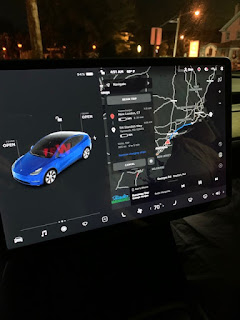
 After a couple of attempts, I was finally able to get access to the Full Self-Driving 'Autosteer on City Streets' beta (otherwise known as FSD beta). Here's what you need to do to get FSD and then the beta -

1) Subscribe to FSD through the app - it's currently $200/month. Or, you can purchased FSD outright - currently, that will set you back $15k....

2) Once it's active, you get access to 6 of the 7 capabilities that are part of FSD -

- Navigate on Autopilot (ability for the car to self-drive from on-ramp to off -ramp on highways).

- AutoPark - car can park itself is parallel or curb parking spots.

- Summon - car can back itself out of, or pull into, a garage.

- Smart Summon - car can autonomously drive to you in a mall parking lot.

- Auto Lane Change - car will initiate and make lane changes automatically when you signal.

- Traffic and Stop Sign Control - when using Autopilot, the car will stop for red lights and stop signs.

The big feature, and the one that everyone talks about, is Autosteer on City Streets. This is currently available as a beta feature so essentially, when you get this, you become a tester for Tesla. Data from your usage is fed back to Tesla to increase the knowledge base in their network. It is still very much a work in progress, as numerous Tesla testers have shown. My own experience after a couple of weeks has shown the same.

To get access to the FSD beta, once you have subscribed or purchased FSD, you then click a button on the car's screen requested access to the beta. Then you have to do a couple of things -

1) Drive 100 miles on Autopilot (which is the Traffic-Aware Cruise Control and Autosteer) - this should be done on a highway.

2) Maintain a decent Safety Score. The SS pops up on the Tesla phone app when you hit that request button on the screen, and monitors your driving habits - specifically, Forward Collision Warnings, Hard Barking, Aggressive Turning, Following Too Closely and Autopilot Disengagements. You typically need to be above an 80 to get access to beta. You have to maintain a score for about 7 days before getting beta access.

So, once you do those 2 things, based on current timeframes, you should get into the beta, and the fun begins!

The first chance I had to try it out was the Wednesday before Thanksgiving. Here are a couple of videos that I took that day -

This first one is just a straight shot down a divided 4-lane road in our town -


The second video is further down the road, preparing to make a turn onto another divided 4-lane -


The final video is making a left-hand turn into my neighborhood. The car in front of me actually did a U-turn which seemed to confuse the car as it basically stopped. I took over as I had traffic behind me.


So that's the initial look. I've done some other tests without videos, but will do some more videos shortly. My subscription ends at the end of December so I have some time. Stay tuned!


EV's in the Comics


Came across this a couple of weeks ago - thought it was funny!


Stay tuned for some new entries - sorry that I haven't been very good about updating this. But I have a lot of material to post!

Wednesday, January 12, 2022

Battery Usage While Stuck


The recent incident with hundreds of cars stuck on I-95 in Virginia during the snowstorm has raised a lot of questions regarding EV vs ICE vehicles - what happens if you're stuck like that in an EV? Won't the battery die quickly if you have to use the HVAC to stay warm?

The short answer is that you'd probably be better off in an EV than a gas-powered vehicle, assuming to have similar level of energy available to power the car. That is, you can't compare an ICE vehicle with, say 3/4 of a tank of gas to an EV with, say, 20% of charge. But assuming both have a similar percentage of their total tank/battery filled, the EV is actually better.

The main reason for this has to do with the engine and motor, respectively, of the ICE vehicle and the EV. The engine in an ICE vehicle is CONSTANTLY running (let's put aside those stop/start systems for a second) - when you start the car until you turn it off. Idle, high-speed, city driving - the engine is always using gas. With an EV, OTOH, the motor(s) is only using energy from the main high-voltage battery when the car is moving under power - that is, accelerating or maintaining speed. Unlike an ICE vehicle, when you remove your foot from the accelerator, the motors do not use energy and actually, through regenerative braking, put some energy back into the battery. So, the major source of energy usage for an EV, the motor, is basically using zero energy when you are stopped. 

So take the situation down in Virginia a couple of weeks ago. You have an ICE vehicle and an EV sitting side-by-side on the highway. The ICE vehicle is idling to keep the heat running - and therefore using gas (and also polluting but that's another story). The EV's motor is using no energy. Depending on the car and the HVAC settings, some energy is used to heat the car, but so little that it could literally take days to deplete the battery from a high state of charge to the point where you'd start to get concerned. This is especially true if you have an EV (like a later Tesla) that has a heat pump. They use less energy from the battery to heat the cabin, just like the heat pump in a home. See the Texas power outage in February 2021 as a great example - here is a link to just one story that discusses how people used their Teslas (in their garage) to survive - 

https://electrek.co/2021/03/05/electric-cars-texas-blackout/

How about a personal example? On Tuesday, my wife had oral surgery and due to Covid regulations I could not wait in the office (I didn't want to anyway). The temperature outside was 19 degrees. I waited for slightly over 2 hours in my car, the heat was set at 70 degrees and I had the seat heater on (probably overkill). I was also watching YouTube videos on the car's screen. My battery SOC went from 81% to 79% in that time frame. Extrapolating that, I could have sat there for another 79 hours before my battery would reach a 0% SOC! And I could extend that time period by lowering the temperature, or turning the heat off altogether and just using the seat heaters. Realistically, when the sun went down, the car would use some energy to keep the battery warm, so 79 hours is probably unrealistic. But the point is that the EV has several advantages over an ICE vehicle that MUST run to provide heat to the cabin.

Ok, so how long can an ICE car idle and provide some heat? Here is an interesting article that can help you calculate for your particular vehicle. 

https://www.autotrader.ca/newsfeatures/20190201/how-long-can-you-stay-warm-on-a-tank-of-gas/

The main example they use - a Ford Explorer - comes out to about 33 hours on a full tank of gas. You can certainly extend that by shutting off the car from time to time, but you'd have no cabin heat and when you restart, the engine is now cold and therefor less efficient. Just like in the EV, you can certainly use the heated seats - but now they are running off of the 12v battery, which you need to restart the car. And you don't want to use the radio when the car is off, as it would further deplete the 12v battery. 

So, the bottom line is that being in an EV might actually be a better choice if you're stuck in a storm. You should certainly take the precautions you would with an ICE vehicle - make sure you have sufficient fuel if you're traveling during inclement weather, have a safety kit, etc. But don't sweat it out in your Tesla, ID.4, Mustang Mach-E or whatever. Just make sure to offer a warm space to those stuck in their gas cars. 😃


Friday, December 3, 2021

Cape Cod Road Trip - August 2021


Hard to believe it, but I never put together a blog entry about our annual vacation trip to Cape Cod back in August.... This was our third road trip, after one to Saratoga Springs in April and one to Boston in May. Better late than never I guess!

We own a time share in West Yarmouth, which is next to Hyannis, the largest town on the Cape. There are only 3 Supercharger locations on Cape Cod, but the Hyannis SC is only about 10 minutes from our time share. So I figured that would be fine as long as it wasn't too crowded. We don't typically drive much once we get to the Cape, other than to dinner and some shopping. Some years we might drive to Provincetown or the National Sea Shore, but didn't have a desire to do the former and the number of shark sightings eliminated the latter from consideration!

We left home at 5:00 am on Saturday, August 7, to head up Route 95. I had charged to 95%, so we had plenty of juice to start, We had one planned stop, in New London, CT, at 26% state of charge, and the car advised charging for 20 minutes (to 75%) to be on our way. We used the restroom in a supermarket and when we got back to the car, it was charged and we were on our way. Between home and New London, we drove pretty efficiently, using 262 watt-hours per mile (similar to MPG with a gas car, except lower is better). That's 82% efficiency, which I was happy with. Cost was $0 as I still had free Supercharging miles from purchasing the car.

We arrived at our destination (the Keltic Kitchen, for traditional breakfast!) and since we couldn't check in until the afternoon, decided to head over to the Hyannis Supercharger for some juice. Our trip from New London to Hyannis was at 88% efficiency, probably helped by some traffic over the Sagamore Bridge (slower speeds). We got there with 21% SOC and let it charge up to 76%, which took about 19 minutes. Again, no cost due to free credit. And the SC location was empty although a pickup truck did park there as we were leaving - an ICEhole.

During the week, I charged once, on Wednesday, from 49% to 90% (no cost), and then again Friday evening prior to heading home Saturday morning (69% => 95%). No cost. I didn't really need to charge up on the Wednesday, I guess, since I only used 21% between Wednesday and Friday evening. Lesson learned.

Saturday, we hit the road at 7:00 am after our traditional stop at Bagels and Beyond. I used the Autopilot while I ate my breakfast driving on Route 25 once we were off the Cape, which was great! We stopped in Madison CT where we charged from 28% to 80% and used up the remainder of our free SC credits and an extra $5.10. Took 21 minutes, enough for a bathroom break. Our efficiency was good at 85% and averaged 281 wh/mi. The remainder of the trip ws on that charge, we arrived home at 27% - 90% efficiency, due to some traffic at the GW Bridge, and attaining 265 wh/mi for this leg.

Overall, this really proved to me how great a road trip car the Model Y is. Our charging time both up and back was 40 minutes combined, which frankly wasn't any longer than we would stop driving up in our Mazda CX-5, which would take an entire tank of gas and cause me agita if we got stuck in traffic at the end of the trip. We would always stop once each way for a bathroom break, so no change there. And since the MY is more efficient in slower traffic is, I didn't have any worries about running out of charge while we were in traffic at either end of the trip. 


Charged and ready to go!


Energy usage, Dayton to New London CT


Charging in New London


Charging in New London


At Hyannis MA Supercharger


The rare Model Y Standard Range spotted at our timeshare!

Wednesday, November 10, 2021

First Comparison of Cost of Electricity vs Gas

 It's been just over 8 months since I took delivery of my Model Y, so I figured I can do a quick initial comparison of the cost of charging (both home and on the road) vs the cost of gas I would have used over the same span of time. 

As of today, the car has 9,102 miles on it. When I compare the cost of my utility bill for the months of April - October of 2020 and 2021, the difference is $248.05 (and yes, this includes natural gas usage as well - I said this is just a quick comparison...😉). On top of that, I have to include the cost of Supercharging while on road trips, which adds another $63.92 for a total of $311.97. So, over the 9,102 miles I've driven, charging cost has been $.034 per mile. This is obviously high as it includes the cost of natural gas used to heat my home and run the hot water heater and gas dryer. At some point, I will go back and use just electricity cost in this calculation, perhaps when I've had the car a year. In addition, I got about 600 miles of free Supercharging which I need to account for somehow but for the purposes of this calculation, I'll assume that it's offset by the fact that natural gas cost is included here. 

On the gasoline side, my Mazda CX-5 got around 22 mpg around town and 27mpg or so on the highway, so I arbitrarily picked 25 mpg as the average. Since gas prices have changed so much in the last year, I also arbitrarily picked $3 per gallon (currently above $3.40 here locally). So, for those 9,102 miles, I would have used 364.08 galls, at $3/gallon, that would have cost $1,092.24 and meant that the cost per mile is $.12. So I saved a significant amount in fuel with the Tesla over my CX-5, even with the cost of natural gas in my calculation.

The conclusion is that while I didn't buy the Tesla purely for the fuel savings, it's pretty remarkable how much less costly it is. Of course, this may change depending on where you live and the cost of electricity, but from what I've seen, New Jersey is in the upper echelon in terms of cost of electricity. And right now, I can't take advantage of off-peak rates as PSE&G hasn't rolled out Smart meters yet, which are needed to track usage by time of day. Once that happens, my cost to charge at home will go down.

In other news, I am able to garage the MY now, as I sold off a project car that had been taking up space for about 20 years.... Pretty excited to be able to get the car in out of the elements for the winter. 


Thursday, August 19, 2021

Charging Fail

 I recently did a short road trip from home here in NJ to visit my parents in Saratoga Springs, NY - drove up Tuesday afternoon and returned Wednesday afternoon. Thought I would just do a quick post regarding the importance of not depending solely on the Tesla Navigation system for charging stops.... Especially if you are still new to the EV world...

Of course, many people wonder what's the deal with doing a road trip with an EV - all the extra time spent charging when you could be driving and filling up at a gas station in 5 minutes and be back on the road.... Well, with the price of gas these days, certainly cost is a factor (electricity is cheaper than gas) and personally, I can't go more than a couple hours without having to make a bathroom break...! And I'm generally not in a huge hurry to get anywhere, so the little bit of extra time is no big deal.

And the amount of time to charge is really overstated by the unknowing. For example, on a recent trip to Cape Cod for a weeks vacation, we stopped once either way, about half way, for about 20 minutes each time. So over the course of a 5 hour trip, 20 minutes was spent charging (and also using the facilities and getting a snack). That's no big deal, especially since if we stopped for gas, we'd spend that time using the facilities and getting a snack = 20 minutes!

But back to my 'fail'... One thing that it's important to do before taking a road trip in an EV is to use a tool like A Better Routeplanner (ABRP) to plan the trip prior to getting in the car and using the Navigation system. The reason it's important is that the native Tesla Nav is a little limited - for example, you can't put multiple destinations in (waypoints), you can't adjust the desired arrival State of Charge (SOC), and it's difficult to adjust which Supercharger you might want to stop at, vs the recommended one. You also cannot 'experiment' with it - you can only navigate from where you currently are, to somewhere else. Apps like ABRP allow you to input all of the info, and also adjust for extra weight in the car, weather conditions and planned road speed. All of which gives more of a comfort level to (especially) new EV drivers. I generally plan the route using ABRP prior to starting my trip, and then when I get in the car and put my destination into the Tesla Nav, compare it to ABRP.

Unfortunately, I did not do this prior to leaving my parents. I had about 30% SOC when I left, so I figured just one stop would be needed and that I would just stop where the car said to stop - which turned out to be the Superchargers at the Albany Crossgates Mall, only about 30 minutes from my parents house. It advised to charge for 30 minutes, and that I'd get enough energy to arrive home at about 12% SOC - which was a little low for my comfort level, so I figured I'd charge an extra 5 minutes to get to around 15%, a more comfortable buffer for me.

However, when I finished charging I noticed that the home SOC was only 9% - which was too low a buffer for me... The other issue was that I still had 3 hours to go to get home, and as noted, I really need to stop after about 2 hours to use the bathroom! So I ended up stopping at the Woodcliff Lake NJ Superchargers and charged for as long as it took my to walk to a Panera Bread and use their bathroom, and back. That was about 5 minutes. After that charge, I'd arrive home with about 31% which was more than enough.

So, I ended up stopping to charge for 40 minutes total. If I had followed ABRP charging instructions, the charging time would have been 32 minutes and I would have arrived home with 20% SOC (again, plenty of buffer for me). So the difference was 8 minutes over a trip of a little over 3 1/2 hours - which may not seem like much, but however you can cut down charging time, you should, especially as the rate of charging slows as the battery fills - that is, it's not linear. So my charging time in Albany was impact by a slowing rate as the battery filled.

BTW, the total cost for those 2 stops was $18.46 for about 265 miles of range. For comparison, my previous Mazda CX-5, which got about 26 mpg on the highway, would have used 10 gallons of gas which would have cost over $33 at current prices.

Screen shots from ABRP:


Monday, May 24, 2021

Road Trip #2! - to Boston


As I mentioned in my previous post, my wife and I did another road trip this past weekend to visit her family (and my cousin) in the Boston area. The drive up was great with minimal traffic so we made good time. I had charged to 100% overnight Friday, so we had a full tank when we left our house a little after 7:00 am Saturday. Following the Tesla navigation, we stopped in Hamden CT to charge - we arrived there at around 52% State of Charge and left at 88%. Because I have free Supercharger miles, it did not cost anything, but would have cost $8.06 if I had to pay. This added about 117 miles for range (see summary of all charge activity and costs below). This SC location is right off the Merritt Parkway and in a shopping center, so there are options for food and bathrooms - very important to me on a road trip! Only a couple cars were charging. 

We also stopped in Littleton MA to charge up, on the way to my cousin's home in North Andover, MA - the car didn't advise us to stop, but I knew that I'd have to stop at some point prior to going to my brother-in-laws house in Needham (about an hour from North Andover) and charging options on that route seemed to be a little limited. So we charged in Littleton, which was actually pretty crowded (9 of 12 stalls were in use when we arrived). So charging there was a bit slow. But we made it to North Andover and then Needham with about 30% SOC, which was my goal.

Sunday, heading home, we made 2 stops to charge - one in Framingham MA and one back in Hamden. Arrived back home on Sunday afternoon with about 25% SOC. 

I could have spent a little less time charging in each location, if I was willing to arrive with a lower SOC. At this point, I prefer to have a little higher charge at my destination just to account for changes in traffic conditions. I guess over time I'll become more willing to simply follow the guidelines and not spend the extra time. I probably spent an extra 15 minutes over the 2 days, above and beyond what the car advised to do.

You can see the overall numbers in the chart below. Total cost of charging would have been just under $36, versus at least $75 in gas (using $3/gal and 25 mpg). So we saved there, although we did add an hour of trip time charging for the entire trip. But we'd be making a bio break anyway, so the extra time aspect isn't really a big deal to me.

I also used the Traffic Aware Cruise Control for about 90% of the ride home. Tesla isn't the only car to have this function, but I'm not sure how many other systems will actually allow the car to come to a complete stop and then accelerate up to speed again - this is really useful in stop and go traffic, which we had for about 10 miles on the NJ Turnpike. It definitely takes a little getting used to, especially when you see brake lights lighting up ahead of you and the car hasn't slowed yet! I set it for 73 mph - that seems to be a good compromise between efficiency and speed. 

I did NOT use the Autosteer function on this trip - this keeps the car centered in the lane. When there is a lot of traffic, I'm not comfortable with it yet as it doesn't correct when a car moves toward you while staying in their lane. Normally, you might correct a bit by moving over in your own lane, but AS keeps you planted in the center - meaning it can get a little close. I use it when there isn't a lot of traffic right now. I guess it will get better with more familiarity. 

So that's it. The car performed well - just like a 'real' car! The ride is good, even on crappy NJ/NY/CT/MA roads. Having the ability to quickly and instantly scoot around a slow guy is really a great feature. The handling is great for a 4500 lb vehicle. Seats are really comfortable and supportive. AC and stereo are awesome. It's a great road trip car! Our next one will probably be to Cape Cod in August, so looking forward to that!


Hamden CT SC

Hamden CT

Charging in Framingham

Charging in Hamden


Friday, May 21, 2021

Recent News

 Planning another road trip this weekend, so just some random thoughts to fill the time....

I did maintenance on the Model Y this past weekend. Added some windshield washer fluid. That's it. Oh, and I checked the air in the tires, using the function on the touchscreen.

I downloaded an app called Tezlab a couple of weeks ago, and ended up buying the Pro version ($50/year). This gives you a lot of detailed info - efficiency, charging details (cost, range added, projected range), efficiency vs temperature, detailed breakdowns for each trip, etc. Pretty interesting stuff. Here are some samples (note that these are since the date I downloaded the app, which was April 16) -

- Overall efficiency is 84% - given that a decent chunk of my mileage to date (2028 miles as I write this) has been highway miles, this isn't bad. Higher speeds = less range. Also, I like the acceleration, so that leads to lower efficiency.... ;-)

- The equivalent of MPG for an electric car is Wh/mi - watt hours per mile. Basically, how much energy you are using for each mile driven (some BEV's, like the Mustang Mach E, use a slightly different calculation of miles per watt hour, which is probably a more direct comparison to MPG). With Wh/mi, lower is better. My cumulative Wh/mi is 284, which isn't bad. In general, keeping below 300 Wh/mi is good. 

- Cost - this is the most interesting aspect - I only charge at night (off-peak rates are about 6 cents per kilowatt hour) and since April 16, my total cost to charge is $14.43 for 1,062 miles of range. As a rough comparison, if I was using regular gas and getting 22 mpg around town (like my Mazda CX-5) I would have spent around $135 (using $2.80 as the price of gas). 

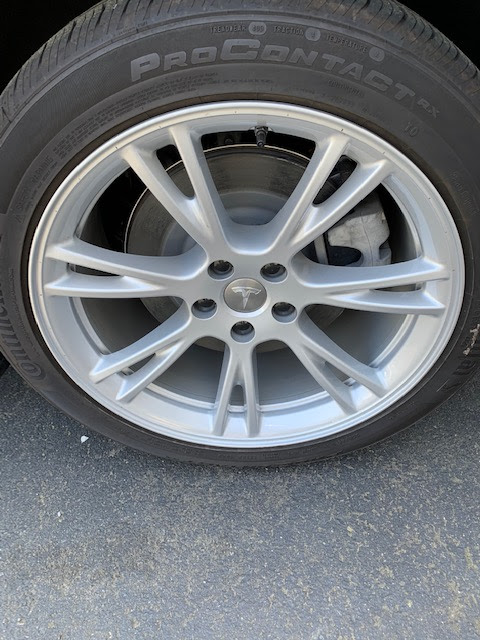
One change I have made to the car is removing the aero wheel covers to uncover the attractive alloy wheels - see pics below for before and after. It will be interesting to compare the efficiency from my trip to Boston this weekend to my previous mostly-highway trip to Saratoga Springs a few weeks ago. It won't be a totally apples-to-apples comparison as temps are definitely higher than they were when we did the Saratoga trip, but it will be fun to compare anyway. I plan to do a writeup on that trip next week.

Stay tuned!


Tuesday, April 13, 2021

First Road Trip!


Road Trip to Saratoga Springs!

Our first road trip with Val was a long-awaited one - a visit to my parents in Upstate NY! Other than 20 minutes in their garage in early December, separated by 20 feet, I haven't seen them since the last weekend of February, 2020. So it was with much anticipation that we set out on Friday, April 9 to visit them!

I had planned to charge to 100% on Friday - 95% overnight and then 'top off' Friday morning. But when I started charging Friday morning, it said it would take well over an hour to go from 95% to 100%, so we ended up leaving at 96%. Tesla Navigation advised we should stop at the Kingston NY Supercharger station (located at a QuickCheck) for a few minutes, and we did, as it was a good stopping point for bio break and lunch. We arrived at about 45% State of Charge (SOC) and were asked to charge for about 6 minutes to 65%, which would have us arrive at my parents at 21% SOC. We ended up charging a little longer (about 20 minutes) while we ate lunch, so left there at 89%, arriving in Saratoga at 45% - using 44% of the battery in that stretch. If I did not have free Supercharger miles, that charge would have cost about $7.79*. 

I had brought my charging cable with me, as I wanted to plug in to my parent's 110v garage outlet just to see how long it would take to charge using that method (vs my 240v plug at home). I plugged the car in Saturday night at 32% SOC at 7:30 pm, and the power barely registered on the screen (see pic #4 below)! It would have taken 24+ hours to charge to the set limit of 95%.... When I unplugged at 9:30 am on Sunday, I was at 52% - so over the course of 14 hours, the battery add 20% of charge. Not very good - so I'm glad I decided to upgrade my outlet at home. My Dad said he'd send me the bill for the charge. 😏

As noted, we left their house on Sunday morning at 52%, with a planned stop at the Guilderland NY Supercharger station (Crossgates Mall). It wanted me to charge for 25 minutes and get to 90%, which would get us home with 12% SOC. I wasn't really comfortable with the buffer, as this was our first road trip, so we charged to about 85% there (after walking around the Mall for about 20 minutes) and planned to stop at the Kingston Supercharger station again for bio break and lunch at QuickCheck. When I plugged in there, I received a notification on my phone that they were only allowing charging up to 80%, as the SC station was busy (about half the 10 stations were currently in use). No big deal as 80% would easily get us home. Sure enough, after we got back in the car, it predicted we'd be at 31% when we arrived home. We actually went a slightly different way than the Nav sent us and got home at 30%. Cost of the 2 charges would have been about $10.67* + $2.90*, respectively.

In terms of my free Supercharger miles, I was charged with using 202 miles between the three stops. Total cost would have been about $21.36* without the freebies. 

Ok, the * next to the charges - these are estimated, as I won't receive a monthly statement from Tesla until early May. The on-line billing statement just indicates these are free charges, using my 1000 free Supercharger miles I got when I used a friend's referral code when buying the car. I'll update this when I can see what the actual charges would have been. I'd expect them to be slightly less. Unfortunately, you can't make a direct comparison to this and the amount of gas I would have used, as I have no cost of charging at home (the initial 95%) or the 20% I did at my parents yet. However, just to give a sense - using our 2014 Mazda CX-5, I would have filled my tank at home prior to leaving which would have cost me approximately $33 (15.3 gallon gas tank, filling it from 1/4 tank to full, gas current price of $2.89). I would have used about 3/4 of a tank on the drive).Assuming the same going home, another $33. So $66 based on today's prices - using 3/4 of a tank twice. 

Enough of the numbers - how was the car? It drove beautifully! I found the ride to be very comfortable, and the seats are excellent - soft but very supportive. At speed, you do get wind and road noise, probably similar to our previous car - actually, probably a bit less as we have no roof rack on the Y and the drag is probably less. You might just notice it more because there is no engine noise. The Traffic-Aware Cruse Control is really great - it maintains a set distance from the car in front of you (you can adjust it) and then goes back up to speed when you pull out to pass. And it works down to zero so can be used in stop-and-go traffic! It did brake sharply when the cars in front of us did at one point, then went back up to speed as they did. Very neat.

I did use the Autosteer function on some stretches of the NYS Thruway. It does a great job of keeping between the lines, so with that function and the TACC, the drive is pretty effortless (you are required to put a little torque on the wheel every 20 - 25 seconds or so, to indicate you're paying attention). I did not use it in heavy traffic as Autosteer does keep you planted in the center of your lane and if someone kind of drifts over to the edge of their lane, it made me a little nervous - especially if it was a truck.. I'm not sure whether it would adjust by moving you to the opposite side of your lane. Will have to test that out. 

We did run into some raining heading home and the auto wipers are great, although they do jump into high-speed mode a little sooner than I prefer. But I also liked that the headlights come on automatically with the wipers. Since that's the law in many states, I don't know why all cars don't do that. 

In summary, I'd have to say the trip was pretty much effortless - a little longer than with our previous gas car, but probably more relaxing due to stopping and eating. There are accommodations to be made when traveling in an EV but only very small ones - and frankly, if I'm not in a hurry, what's the big deal with an extra stop? I'm looking forward to our next trip! It may be a trip to visit family in the Boston area in May. 


Charge status at home before heading out - actually charged up to 96%.


Charging at Kingston NY on the way to Saratoga.


Watching the charger ramp up!


Plugged in to 110v at my parents - this is gonna take a while!


Fast charging at Guilderland SC!


Back at Kingston on Sunday, much busier - limited to 80%.


Back home and plugged in, 500 miles later!


Tuesday, April 6, 2021

Tesla Model Y One Month Report


It's been exactly one month since I picked up my Tesla Model Y - christened 'Val' due to the build date of February 14 - and I have to say, as a quick summary - it has exceeded all of my expectations to date!

I guess that is kind of a boring take, and frankly, there are a few things I don't like about the car - or, maybe I should say 'like less' because there isn't much to dislike about it. I'll also note that this early update is before I've taken any road trips - we do have one scheduled to Upstate NY this coming weekend, and I figured that would be worth it's own report. 

But let's start with the good stuff..... I did a lot of research prior to purchasing this car, leading to a reasonable (but high) set of expectations going in. I had read about the quality issues (panel gaps, paint issues, dirt/smudges from factory handling) as well as the range "issues" (I put that in quotes because people had unrealistic expectations that the car would match the EPA rating of 326 miles, when in reality very few cars match their ratings, ICE or otherwise). I also made sure that I had a home charging set-up as well as some key accessories ordered (floor mats, jacking pucks, shelves for the console, front license plate holder).So I felt fully prepared for the car.

I have to say that my expectation level has been blown away! Upon pickup, after a scan of the exterior and interior, I have to say that the panel gaps were all perfect, no dirty spots in the interior and the paint quality seems very good to me. The color is fabulous! So the initial impression was great!

The driving experience is way beyond anything I expected, even after 2 test drives. The car is totally silent and the wind and tire noise is much less than anticipated. The acceleration is addicting. The technology, in most cases, is very easy to access and works well. Having Spotify available 'in the car' vs streaming from the phone is great, although I wish we also had Sirius/XM in the same format. (See below for some comments on how this all works - this is one of the 'less liked' features of the car.) The sound system is very good to my ears - good bass levels out of the box, and better when pumped up a bit, like I prefer. The voice commands seem pretty comprehensive as well, although I am still learning them. One strange omission seems to be the ability to turn on all of the exterior lights via voice. But maybe it's there and I haven't used the correct command. 

There are a lot of things you can tailor to your preference - the usual seat/mirror/steering wheel position (which are saved in your driver profile) but also driving mode (Chill/Standard/Sport) as well as steering effort (Comfort/Standard/Sport) Driving mode affects the acceleration and regen braking (tones both down a bit). I've been doing Standard and Sport and that seems to be good for me.

I've also tested out the Traffic Aware Cruise Control and Autosteer. TACC essentially allows you to set a following distance from another vehicle and the car will maintain that distance when in cruise control, and when you pull out to pass will accelerate back up to your set speed. Autosteer - which is an additional function - keeps the car centered in it's lane while using TACC. Pretty cool and it seems to work pretty well in the few times I've engaged it. You can use TACC without Autosteer but not vice versa. This is the standard Autopilot suite that comes with the car.

I did run the battery down to about 25% a couple of weeks ago, so I could check out the Supercharging experience. I went to the location in North Brunswick, 10 minutes from my home. It charged from 25% to 50% in about 11 minutes, adding 48 miles of range in that time. It charged at up to 115 kW, which is below the rated speed of 150 kW at that location - but the temp was only 40 degrees so that probably impacted it. But the process is the same as at home - pull up, park, plug. No big deal. And if I didn't have the free miles, it would have cost me about $5.00. So pretty cheap. The next test will be to try out a non-Tesla charging point - I set up accounts with ChargePoint, Electrify America and EVgo and will try one of those that is close to my home next week.

I mentioned earlier some of the foibles of the sound system - Spotify is included on the car and you can easily stream anything from your phone. For example, SiriusXM - you can stream from the phone but it's occasionally a little clunky - if you exit the car and then come back in, taking the phone with you, it takes a few minutes (literally) to reconnect. And with Spotify, if you leave that to listen to another format (FM radio or stream from the phone), the playlist goes back to the very beginning and then will shuffle from there. Ideally, it should simply pick up where it left off until you change the playlist. Maybe in a future software release. 

I've also had an intermittent issue with the car connecting to the home Wifi network. Most of the time it works fine but a couple of times I've had to reboot the screen to get it to work. That's important because the car won't download a software update unless connected to Wifi. I will say that since the last time I did this 2 weeks ago it's been fine.

The final 'complaint' is that the 2 USB-C ports on the back of the console, intended for rear seat passengers, don't seem to be working. I'm sure those can be fixed with mobile service, but I'm not going to have them come out for just that.

So that's it for now. Next update will be after our first road trip!


New for Christmas 2025!

  Makes a Great Gift for those that love to subsidize the Oil Companies!